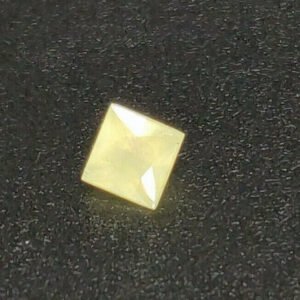
Aragonite
Aragonite represents the “polymorphic twin” of the carbonate world. While chemically identical to Calcite, it is a mineral I have always respected for its more “architectural” and compact orthorhombic structure. In the Czech Republic, this species reaches a level of “crystalline elegance” that is truly world-class. It typically presents as beautiful, “honey-colored” to “amber” hexagonal-looking prisms or as branching, “coral-like” formations known as flos ferri. For the specialist, Czech Aragonite is a prize of transparency and symmetry; the crystals from this region possess a “liquid” clarity and a sharp, tabular habit that makes them a true structural pillar for the systematic vault.
The Heritage & Discovery
Historical Significance: Aragonite from the Czech Republic, specifically the Bohemian region, has been a vital part of European mineralogy for centuries. Historically, the “honey aragonite” from the thermal springs of Karlovy Vary (Carlsbad) was so famous that it was carved into decorative objects for the aristocracy. In the world of fine minerals, it is celebrated for its pseudomorphosis and twinning; the iconic “six-sided” prisms are actually complex twins of three orthorhombic crystals growing together. It stands as a symbol of balance and geological heat, bridging the gap between common sedimentary rocks and the elite world of “gem-grade” carbonates. It serves as a reminder that the same chemical formula can produce two entirely different “personalities” in nature.
Discovery: While the species was formally named in 1797 after the Aragon region of Spain, the Czech occurrences provided mineralogists with some of the first clear looks at thermal-spring deposition. Scientifically, it is the high-pressure polymorph of calcium carbonate. Its discovery in the volcanic and thermal vents of Bohemia allowed for a deeper understanding of how heat and mineral-rich waters interact to create metastable crystals. My own respect for this material grew from observing its extraordinary “warmth”; the Czech specimens possess a particular “burnt-orange” to “amber” hue that feels far more substantial than the pale Aragonites found elsewhere.
Important Mines: The undisputed world capital for the finest “honey-colored” Aragonite crystals is Hořenec (near Bilina) in the Ústí Region, Czech Republic. These specimens are legendary for their sharp, pseudo-hexagonal terminations and “root-beer” transparency. I also have a high regard for the spectacular “pisolitic” (pea-stone) formations from Karlovy Vary. For the vault, I prioritize the Hořenec material for its unmatched crystal definition and its characteristic “amber-glow” saturation.
Mineralogical Profile
Description: Aragonite is a calcium carbonate that crystallizes in the orthorhombic system. It sits at a 3.5 to 4 on the Mohs scale, making it a relatively soft mineral that requires careful handling. It is characterized by its vitreous to pearly luster and its wide range of “earth-and-honey” colors.
One of its most identifying traits is its lack of the rhombohedral cleavage found in Calcite; instead, Aragonite possesses a distinct, one-directional cleavage ({010}) and an uneven fracture. It has a high refractive index ($n \approx 1.53$ to 1.68) and a specific gravity ($SG \approx 2.95$), making it feel slightly denser than Calcite. Because it often forms in volcanic cavities or thermal deposits, it is often found in association with Calcite, Siderite, and Native Sulfur. When I select a piece for the collection, I look for “sharp” pseudo-hexagonal outlines and a “liquid-amber” interior, as these highlight the sophisticated, three-dimensional geometry that makes Czech Aragonite a standout for the systematic specialist. It is a dense, high-vibration mineral that offers a unique, “architectural” beauty unlike any other carbonate.
Chemical Formula: CaCO3